Specialist investigation and management of fertility difficulties, with personalised treatment plans tailored to your circumstances and conception goals.
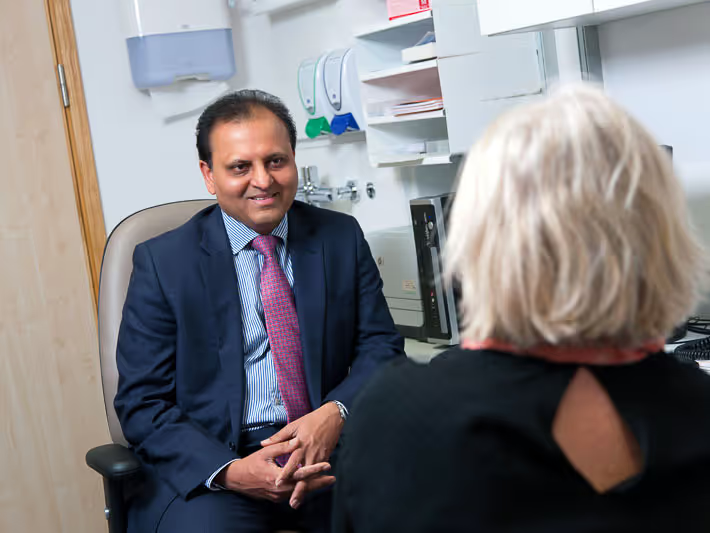
A fertility assessment is a thorough investigation to identify the underlying causes of difficulty conceiving. If you have been trying to conceive for over a year without success — or over six months if you are over 35 — a specialist assessment can help establish the reason and guide you towards the most appropriate treatment. Fertility difficulties are common and, in many cases, highly treatable.
Unable to conceive after 12 months of trying (or 6 months if over 35)
Irregular or absent periods
Known or suspected endometriosis, fibroids, or polycystic ovaries
Previous pelvic infection or surgery
Recurrent miscarriage
Partner with known or suspected sperm difficulties
A fertility assessment involves a clinical review of your medical history, hormonal blood tests, pelvic ultrasound scan, and assessment of the fallopian tubes where indicated. Your partner's sperm may also be assessed as part of a complete picture.
Treatment depends on the identified cause, your age, and your personal circumstances:
Fertility medicines to support or stimulate ovulation (e.g. metformin, clomifene, gonadotrophins)
Laparoscopic surgery to treat endometriosis, fibroids, or blocked fallopian tubes
Laparoscopic ovarian drilling for polycystic ovaries
Intrauterine insemination (IUI)
In-vitro fertilisation (IVF)
Surgical sperm extraction (where required for partner)
At London Pregnancy Care and Gynaecology, care is delivered by experienced consultant specialists with a focus on personalised treamtent, continuity of care, and clear, supportive guidance.
If you have been trying to conceive for 12 months without success, it is advisable to seek specialist advice. If you are over 35, you should consider a consultation after six months of trying. A fertility specialist can identify underlying causes that a GP may not be able to investigate fully, and advise on the most suitable course of treatment.
If investigations show you are not ovulating regularly, medications can help stimulate ovulation. For women with polycystic ovaries, metformin has good evidence for improving ovulation and conception rates. Other options include clomifene and gonadotrophins. These medicines are most effective when a specific ovulation problem has been identified.
Surgery may be recommended where there is a structural cause for fertility difficulties. Laparoscopic surgery can treat endometriosis, remove fibroids that are distorting the uterine cavity, repair damaged fallopian tubes, or carry out ovarian drilling for polycystic ovaries. Surgical options may also be available for a partner with a sperm transport problem.
IUI involves selecting the best quality sperm and introducing them directly into the womb via a fine tube passed through the cervix, timed to coincide with ovulation. It is a painless procedure suitable for couples with mild sperm difficulties, mild endometriosis, or unexplained infertility. For women under 35 with healthy fallopian tubes, conception occurs in around 15% of cycles.
IVF involves stimulating the ovaries to produce additional eggs, which are collected and fertilised with sperm in a laboratory before being reintroduced to the womb. It is recommended when other treatments have not been successful, when there are significant sperm problems, or when infertility is unexplained. Success rates are approximately 30–40% per cycle for women under 35.
Yes. Fibroids that distort the uterine cavity can reduce the chances of conception and implantation. Endometriosis can affect the fallopian tubes and ovaries. Both conditions can often be treated surgically to improve fertility outcomes. Your consultant will advise on the most appropriate approach for your situation.






















.avif)
.jpg)