Expert planned and emergency caesarean delivery, with personalised care and clear guidance throughout your pregnancy and birth.
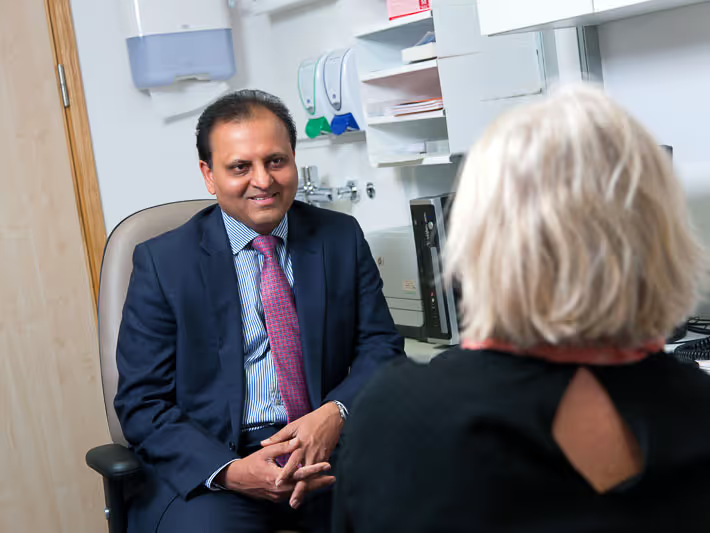
A caesarean section (C-section) is a surgical procedure to deliver your baby through a cut made in your abdomen and womb, usually just below the bikini line. Most caesareans are performed under spinal or epidural anaesthetic, meaning you remain awake and your birth partner can be present. A caesarean may be planned in advance or carried out as an emergency if a vaginal birth is considered too risky. Mr Kunde supports every woman's right to make an informed choice about her birth.
Breech presentation
Placenta praevia (low-lying placenta)
Twin or multiple pregnancy
Foetal growth restriction
Failure to progress in labour
Foetal distress during labour
Personal choice following careful consideration of risks and benefits
The need for a caesarean — whether planned or emergency — is determined through clinical assessment, ultrasound scanning, and ongoing monitoring during pregnancy and labour. Your consultant will discuss your individual circumstances and the reasons for recommending a caesarean delivery.
Most caesareans are performed under spinal or epidural anaesthetic and take approximately 40–50 minutes. A cut of around 5 inches is made across the lower abdomen, and your baby is delivered through the opening. You may feel some tugging and pressure but no pain. The screen is lowered as your baby is born, and skin-to-skin contact is encouraged immediately after delivery. The incision is closed with dissolvable sutures and sealed with a waterproof glue dressing.
At London Pregnancy Care and Gynaecology, care is delivered by experienced consultant specialists with a focus on personalised treamtent, continuity of care, and clear, supportive guidance.
A planned (elective) caesarean is usually performed after 39 weeks of pregnancy and may be recommended for medical reasons including breech presentation, placenta praevia, twin pregnancies, or foetal growth restriction. In some cases it may be performed before 39 weeks if there is a clinical reason to deliver earlier.
Yes. If you have carefully considered the risks and benefits of the procedure, you are entitled to choose a planned caesarean. Mr Kunde will discuss the advantages and risks of the operation with you fully and answer any questions you have, so you can make an informed decision.
On arrival in theatre, a cannula is placed in your arm for fluids and antibiotics, and a spinal or epidural anaesthetic is administered in your lower back. Once the anaesthetic is fully effective, a urinary catheter is inserted and your abdomen is cleaned. A cut is made across your lower abdomen and womb, and your baby is delivered. You will feel some tugging and pulling but no pain. Your birth partner can be with you throughout, and you will be able to hold your baby and have skin-to-skin contact shortly after delivery.
Recovery from a caesarean typically takes longer than recovery from a vaginal birth. You will usually remain in hospital for two to three days. Some abdominal pain is expected in the first few days and pain relief will be provided. Once home, you will need to rest and avoid certain activities such as driving for around six weeks. The wound scar may appear red and swollen initially but will fade over time. After three to four weeks, you will be advised to gently rub the glue dressing during showering as it begins to peel away.
A caesarean is generally a safe procedure, but as with any surgery it carries some risk. Possible complications include wound or womb lining infection, blood clots, excessive bleeding, and inadvertent damage to nearby structures such as the bladder or ureter. Temporary breathing difficulties in the baby and, very rarely, accidental cutting of the baby during delivery are also recognised risks. Your consultant will discuss these with you fully before the procedure.
After one caesarean section, a vaginal birth in a subsequent pregnancy is often possible, provided there are no medical conditions requiring a planned caesarean. You will be advised to wait at least 18 months before becoming pregnant again to allow the scar to heal fully. Your consultant will discuss your individual options with you.





















.avif)
.jpg)